ServicesWater Filtration
Whole Home Water Filtration in La Vergne
We test your water first, then install a point-of-entry system on your main line that treats what you actually have: chlorine taste, sediment, hard-water scale or all three. The same small crew that tests your water installs the system and shows you how to maintain it.
What a whole home system does, and when it makes sense
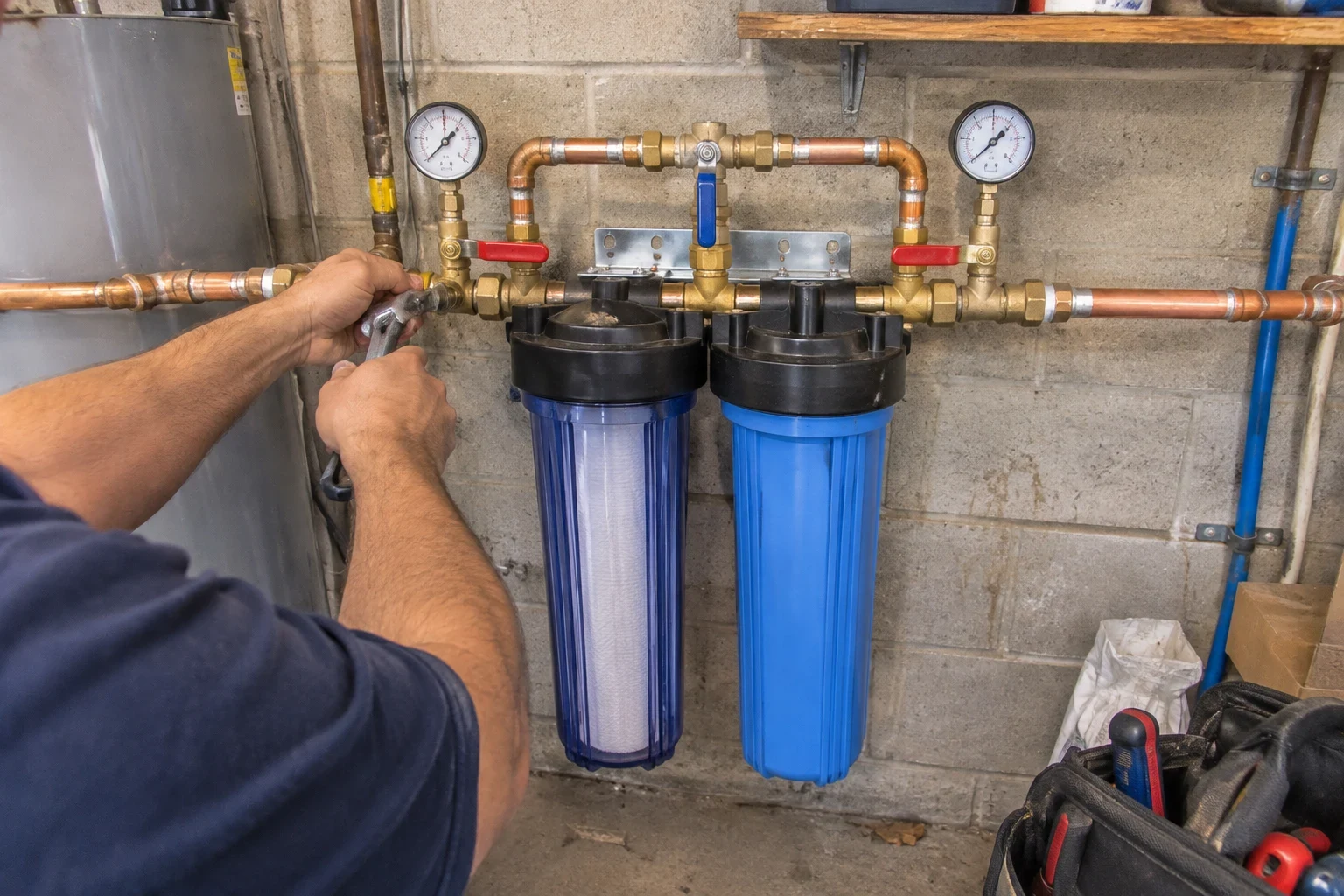
A whole home filter sits where the water line enters your home, before the water heater and before the first branch. Every fixture downstream gets treated water, not just the kitchen sink. That matters because chlorine and scale do their damage in showers, washing machines and water heaters, not only in the glass you drink from.
Middle Tennessee sits on limestone, so hardness is common, and city water is disinfected with chlorine or chloramine. A under-sink unit can fix taste at one tap. It can't stop calcium carbonate from building up inside a tankless heat exchanger or a dishwasher valve. If your problem shows up at more than one fixture, a point-of-entry system is usually the right call.
We keep the job with one small crew. The person who reads your water test is the person cutting the system into your line, so nothing gets lost between the estimate and the install.
What the installation includes
Water testing before we recommend anything
We check hardness, chlorine, iron and pH at your home. The numbers decide the equipment, so you are not sold a softener you don't need or a carbon tank too small for your chloramine level.
Sediment prefilter
A spin-down or cartridge sediment stage catches sand and pipe scale before it reaches the carbon or resin. Without it, the main media fouls early and flow drops.
Carbon or catalytic carbon stage
Standard activated carbon handles chlorine well. Chloramine breaks down slowly on regular carbon, so where it's present we use catalytic carbon with enough bed depth and contact time to actually remove it.
Scale control or softening
For hard water we install either an ion-exchange softener or a salt-free scale-reduction unit, depending on your test and whether you want true softening or just less buildup.
Bypass loop and gauges
Every system gets a three-valve bypass so you keep water during service, plus pressure gauges before and after the filters. When the pressure difference grows, you know a cartridge is loaded.
Drain and bonding work
Backwashing tanks need a drain line with a proper air gap. If we cut into copper that grounds your electrical system, we add a bonding jumper across the new equipment.
Signs your home needs whole home filtration
White crust on fixtures
Calcium and magnesium leave scale on showerheads, faucet aerators and glass doors. The same deposits are forming inside pipes and appliances where you can't see them.
Chlorine smell in the shower
Hot water releases chlorine as vapor. If you notice it while showering, a kitchen filter isn't reaching the problem.
Short-lived water heaters and appliances
Scale insulates heating elements and burner surfaces, so they run longer and fail sooner. Tankless units often throw scale codes in hard water.
Dry skin and stiff laundry
Hard water keeps soap from lathering and leaves mineral residue in fabric and on skin.
Grit or color in the water
Sediment after city line work or in a well system can clog aerators and wear out valve cartridges.
How install day runs
- 1
Test and plan
We test your water, look at where the main enters your home and measure the line size. You get a written estimate that names each component and why it's there.
- 2
Prepare the space
We lay down floor protection, shut off the main and drain the line. Tanks go on a level base with room left for cartridge changes and salt loading.
- 3
Cut in the system
We install the bypass, connect the stages in order (sediment, carbon, then softening) and add a drain line and bonding jumper where needed.
- 4
Start up and flush
New carbon releases fines, so we flush each stage to drain, check every joint under pressure and set the softener's regeneration schedule to your hardness and household size.
- 5
Walk you through it
Before we leave, we show you the bypass valves, the gauges and how to change a cartridge. Then we clean up and haul away packaging and old pipe.
What moves the price
The cost depends mostly on what your water test shows and how your home is plumbed. We price after testing, not before, and the estimate is free. Financing options are available, and we accept all major credit cards and cash.
- Your water chemistry
- Chlorine alone needs one carbon stage. Chloramine, high hardness or iron each add media or equipment.
- Flow rate and line size
- A larger home with several bathrooms needs bigger tanks and a wider valve body so pressure holds when two showers run at once.
- Access to the main line
- An open garage wall is quick work. A main that enters under a finished room or in a tight crawlspace takes more labor and rerouting.
- Drain and power needs
- Backwashing tanks and softeners need a drain nearby and sometimes an outlet. Running either adds to the job.
Whole home filtration questions
Something not covered here? (615) 454-9146
Will a whole home filter lower my water pressure?
A correctly sized system causes only a small pressure drop. Problems come from undersized cartridges or a clogged sediment stage. We size the valve and media to your peak flow, and the gauges tell you when a filter needs changing.
Is a water softener the same as a filter?
No. A softener swaps calcium and magnesium for sodium or potassium to stop scale. A carbon filter removes chlorine, taste and odor. Many homes need both, and the water test tells us which.
How often do filters need changing?
Sediment cartridges usually need changing every few months, depending on how much grit your water carries. Carbon tanks last much longer, and softeners need salt added as it runs low. We tell you the schedule for your specific setup.
Does filtration help a tankless water heater?
Yes. Scale is the main cause of tankless heat exchanger problems in hard water. Treating water upstream cuts down on descaling and error codes. If you're also planning a tankless water heater installation, we can plan both together.
Where does the system go?
Usually in the garage, basement or utility area near where the main line enters your home. It has to be upstream of the water heater, and outdoor installs need protection from freezing.
Find out what's in your water
We'll test your water at your home, explain what the numbers mean and price a system that fits. The same crew carries it through install and startup.